
How AV Consulting Services Save Time, Money, and Headaches in Projects
How AV Consulting Services Save Time, Money, and Headaches in Projects
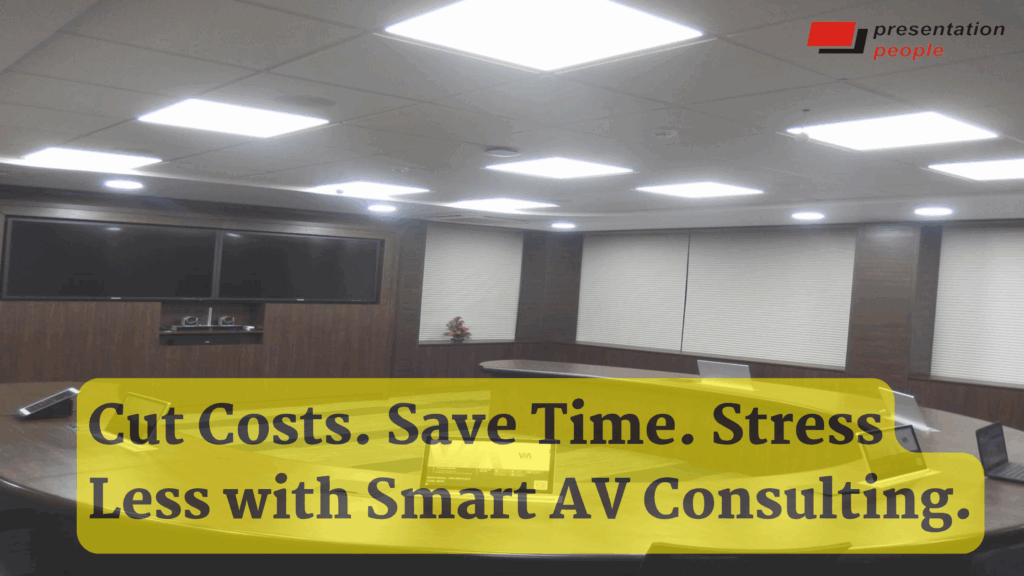
When businesses build new offices, training rooms, or meeting rooms, technology is an afterthought. Architects think about space planning, interior designers select furniture and finishes, and IT plots the network.
Nobody asks, “Where does the screen go?” until the very end. That’s when budgets begin to stretch, timelines slide, and headaches start to stack.
That’s where AV consulting services become valuable. By hiring an expert at the beginning of your project, you can avoid costly mistakes, save weeks of effort, and create spaces that actually support the way people want to collaborate and connect with each other.
Below, we talk about the benefit that AV consultants bring to projects, and how their expertise saves not just money, but time and frustration for everyone.
Why AV is more important than most of us know
AV is short for audio-visual—everything from screens and microphones to speakers, cameras, and controls. It’s the infrastructure of today’s communications, particularly with hybrid work being the new norm.
Remember the worst meeting you ever attended. Perhaps the sound was reverberating so grotesquely that you could not even hear the speaker. Perhaps the camera was set up in an inappropriate position and cut off half of your employees from sight. Or perhaps the screen was so tiny that slides were illegible. All those moments are not just frustrating—time-wasters, decision-slowers, and reputation-drainers for your company.
AV consulting services avoid those complications. Rather than hope the TV mounts “best,” or hope the mic “just works,” consultants build solutions based on tried standards, actual measurements, and years of experience. Their aim is simple: build a space where people can see, hear, and speak easily.
How AV consulting services save you time
- Planning early = less delay
If you install AV at the last moment, it tends to be in conflict with building designs. You discover suddenly that a wall requires an additional conduit, or the projector’s mount requires support from the structure. Sigh. To correct these issues at the last minute means to halt work, re-design, and obtain approvals—all of which consume precious time.
AV consultants collaborate with architects and contractors from the beginning. They define power requirements, cable runs, lines of sight, and equipment locations up front so everything gets along famously. The reward? Reduced surprise and a schedule that remains on track.
- Detailed documentation keeps teams in sync
An AV consultant will not just say “put a screen there.” They provide drawings, specs, and standards that everyone can work from. Electricians know where outlets go. IT folks know where to set up the network. Contractors know where to leave room for racks or ceiling speakers.
That kind of specificity avoids back-and-forth arguing and miscommunications that can delay a project for weeks.
- Quicker adoption when space is live
Time savings don’t begin and end with construction. When systems have been properly designed and tested, employees can walk into a new room and start using it immediately. There is no test-and-adjust period when IT must be called in over and over to sort things out. Meetings start on time, and your people accomplish more.
How AV consulting services save you money
1. Preventing change orders
In construction, a change order, the “we have to redo this,” is one of the biggest budget-drainers. Saving thousands by relocating a screen, re-running outlets, or re-building half a ceiling to correct AV oversights is a no-brainer. Consultants save these dollars by ensuring that things are well-designed the first time.
2. Selecting the proper equipment
It’s simple to spend too much on AV equipment. Perhaps you choose an enormous monitor because “bigger must be better.” Or perhaps you purchase too many microphones, thinking more is better. Too-small equipment, by contrast, causes frustration and expensive replacement downstream.
Industry professionals utilize industry norms to make decisions on screen size, camera location, and sound. That is, you only purchase what you require—nothing more, nothing less.
3. Long-term reliability
A hasty system might be up and running on day one, but not in a few months’ time under the weight of heavy use. Recurrent breakdowns sum to service calls, maintenance, and irritable personnel. Consultants plan systems for the long term. They choose heavy-duty equipment, plan enough ventilation for equipment racks, and invoke best-practice monitoring. It all lowers the cost of maintenance over the life of the system.
How AV consulting services save you headaches
1. Better sound, less pain
Noisy audio is the one thing that will break a conference sooner than anything else. Echo, background noise, or volume imbalance is distracting and difficult to listen to. AV consultants design acoustics, select the proper microphones, and position speakers so that each voice clearly resonates through. They usually ensure speech intelligibility with respect to standards, so you can be certain the room will perform prior to delivery.
2. Natural video
We’ve all seen conference calls where participants look like tiny figures in the corner of the screen or where the camera is pointed at the ceiling. Consultants consider viewing distances, camera angles, and lighting to create a natural, comfortable video experience. Remote participants feel included, not like outsiders peering in.
3. Simple, user-friendly systems
Another of the most prevalent complaints about AV systems is complexity. Too many remotes, bewildering touch screens, or nonstandard arrangements enrage users. Consultants are aimed at usability. They engineer systems where a single button initiates a meeting, where connections are consistent room-to-room, and where training is zero. That cuts down on support calls and leaves employees working on their job, not on the gear.
A real-world example
Picture a business constructing a new headquarters with a dozen conference rooms. In the absence of AV consulting, they may select displays by trial and error, mount speakers wherever there is room, and not consider cameras until furniture is in place. The outcome? Rooms where individuals are unable to read slides easily, audio drops in and out, and participants who join remotely feel disconnected.
Now imagine the same project with an AV consultant from the very beginning. The consultant specifies the size of each screen so that text can be legible from the rear row. He or she designs mic coverage so that each voice will be audible. He or she consults with the architect to position cameras at the appropriate height and lighting so video conferencing is convenient. When the spaces are open, it all functions. No complaints, no retrofits, no dollars wasted.
Why it matters now
It’s no longer an experiment, according to Zoho—hybrid work is business as usual. Your meeting rooms are places of physical presence and virtual locations. They need to accommodate employees in the office along with remote collaborators and customers.
If those rooms don’t work, meetings drag on and on, communication falters, and teams stall. Properly designed AV systems, meanwhile, facilitate effortless collaboration, with a straight-line effect on productivity and employee engagement.
Spending on AV consulting services is thus not an indulgence—it’s a savvy business move.
Last thoughts
All organizations want to save time, come in on budget, and avoid stress on projects. AV consultants do just that for you. They think ahead, eliminate guesswork, and create systems that simply work.
No matter the installation, whether a local meeting facility or a global network of hybrid spaces, investing in an AV consultant at the beginning is the most effective method for getting it done correctly the first time. The result is an on-time, on-budget project with technology that is a joy to use.
So if you’re developing a new space or reconfiguring your existing one, be sure to include AV consulting services. You’ll save time, money, and a whole lot of headaches—and your teams will thank you with every step into a room that just works.